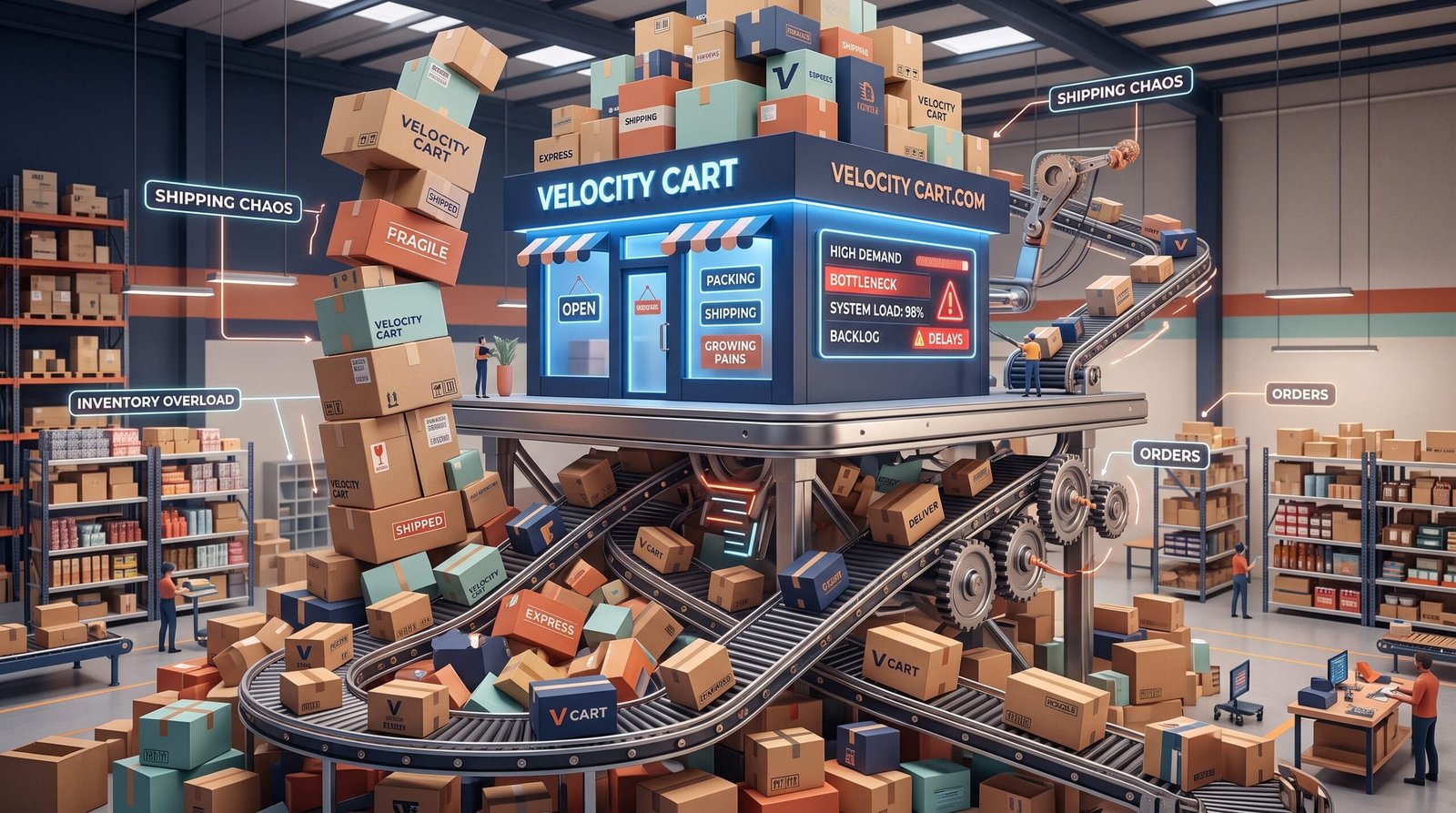
Growing sales is good news for any online store. But growth also exposes weaknesses that may have gone unnoticed when the business was smaller.
Processes that worked perfectly with a limited number of orders can become slow, complicated or error-prone as sales increase. Inventory becomes harder to control, order management takes more time, customer enquiries multiply and the ecommerce platform may start to show its limitations.
In many cases, the problem is not selling more. The problem is having an online store that has not evolved at the same pace as the business.
Identifying these issues early makes it easier to make better technology decisions and avoid growth affecting customer experience, operational efficiency or profitability.
What happens when an online store starts to grow?
Ecommerce growth is not simply about receiving more orders. Every additional sale generates a series of processes that need to work correctly: checking stock, processing payments, preparing shipments, updating information, communicating with customers and managing returns or incidents.
When order volumes are low, many of these tasks can be handled manually. As the business grows, however, this approach becomes increasingly difficult to maintain.
Growth can also mean a larger product catalogue, more suppliers, new markets, additional payment methods and a greater need to connect different systems.
As a result, some problems appear gradually and may go unnoticed until they begin to have a direct impact on the business.
1. Inventory management becomes more complicated
One of the first problems a growing ecommerce business may face is inventory control.
With a small catalogue, keeping stock information up to date is usually straightforward. As the number of products and orders increases, maintaining this information manually becomes much more difficult.
A stock management error can lead to uncomfortable situations: selling a product that is no longer available, discovering too late that an item is out of stock or showing products as available when they should not be.
The situation becomes even more complex when several warehouses, physical stores or sales channels share the same inventory.
When inventory becomes difficult to manage, the solution is not necessarily to work faster. In many cases, the business needs a better way of updating and sharing information.
2. Order management starts taking too much time
Another common warning sign is that order management begins to consume a significant amount of the team's working day.
Reviewing orders, checking payments, preparing information for logistics, sending notifications and updating order statuses can be relatively simple when volumes are low.
The problem appears when order numbers increase and every order requires several manual actions.
At that point, automating specific tasks can have a significant impact. For example, order status updates or certain customer notifications can be triggered automatically when predefined conditions are met.
The goal is not to remove human involvement where it adds value. It is to prevent employees from spending time on repetitive tasks that do not require a decision.
3. Human errors become more frequent
The more operations are performed manually, the greater the possibility of making mistakes.
An incorrect product reference, a wrong address, an outdated price or an order that has not been processed correctly may seem like minor problems individually. Repeated over time, however, they can create a real cost for the business.
There is also the time required to identify and correct the problem, as well as the potential impact on the customer.
For this reason, ecommerce growth is often a good opportunity to review which processes depend too heavily on manually entering or transferring information.
4. Customer service receives more enquiries
More sales can also mean more questions.
Customers may want to know where their order is, whether a product is available, how returns work, which payment methods are accepted or when their order will arrive.
If all this information requires a member of the team to respond manually, the workload can increase quickly as the customer base grows.
A well-designed online store should make it easy for customers to find the most common information themselves.
A useful customer area, clear order information and automated communications can reduce unnecessary enquiries and allow the team to focus on cases that genuinely require human attention.
5. The ecommerce platform starts to become a limitation
A platform that is perfectly adequate when a business first starts selling online may not be sufficient several years later.
The problem does not always appear as a clear technical failure. It may simply become increasingly difficult to add new features, integrate other systems or modify existing processes.
Another warning sign is when every change requires significant technical work.
When this happens, the business may end up adapting its processes to the limitations of the technology rather than using technology to improve the way the business operates.
A well-planned and scalable architecture can help reduce this type of dependency.
6. Integrations become essential
As an ecommerce business grows, new tools and systems are often introduced.
The online store may need to communicate with business management, accounting, logistics, marketing, customer service or other external systems.
If these systems are not connected, the same information may have to be entered several times.
This does not only waste time. It also increases the risk of different systems containing different versions of the same information.
Integrations allow relevant data to move automatically between systems when the technical architecture and business requirements support it.
7. The product catalogue becomes harder to manage
Growth can also make product management considerably more complex.
An online store that starts with a few products may eventually have hundreds or thousands of products, variations, categories and attributes.
At that point, updating information product by product can become inefficient.
Maintaining a clear category structure, updating product images and managing different commercial conditions can also become more demanding.
A good catalogue management system should allow the business to handle more information without every new product creating a disproportionate amount of work.
8. Promotions become more complex
As the business grows, so does the need to run commercial campaigns.
Temporary discounts, volume-based promotions, promotional codes, special conditions and customer-specific campaigns may require greater flexibility.
If every promotion requires significant technical changes, the commercial team loses the ability to react quickly.
For this reason, it can be valuable to have tools that allow certain commercial rules to be managed easily from the ecommerce administration system.
9. Performance can become an issue
An online store with more products, users and transactions may also place greater demands on its technical infrastructure.
A website that performs well with limited activity may require optimisation as traffic and the amount of information being processed increase.
Performance depends on many factors, including architecture, hosting, code, databases, images and third-party integrations.
For this reason, when an online store begins to grow, it is worth monitoring its performance and identifying bottlenecks before they have a significant impact on users.
10. The checkout process starts losing efficiency
Growth can also reveal problems in the purchasing experience that were previously difficult to notice.
A checkout process that is too long, unclear information, payment errors or complicated navigation can all create friction and affect the ability to turn visitors into customers.
As the number of users increases, it is worth analysing where customers abandon the purchase process and which parts of the journey create the most friction.
Major changes are not always necessary. Sometimes small improvements to navigation, product information or checkout can make the purchasing experience considerably easier.
11. Internal management becomes more complex
The growth of an online store also changes the way the business is organised.
Tasks that could initially be managed by one or two people may eventually involve different departments or members of the organisation.
This makes it increasingly important to define who can access each part of the ecommerce system and which actions each user can perform.
A suitable permissions system can reduce mistakes and prevent users from having access to settings they do not need.
12. Security requirements increase
A growing online store processes more orders, customer accounts and business information.
Security therefore needs to evolve alongside the business.
Keeping systems updated, controlling access, protecting administrator accounts and having appropriate backup and recovery procedures are all important elements of a reliable ecommerce infrastructure.
Security should not only be addressed after an incident occurs. It is part of the infrastructure required to maintain a stable online business.
13. International growth introduces new requirements
For some businesses, growth means starting to sell in other countries.
This can introduce new requirements related to languages, currencies, taxes, payment methods, logistics and commercial conditions.
An online store that was not designed with future expansion in mind may encounter significant limitations when the time comes to enter new markets.
This does not mean that every possible international feature needs to be implemented from day one. It does mean that future growth should be considered when making important architectural and technological decisions.
How can you tell if your online store is ready to grow?
You do not have to wait until the ecommerce platform starts failing to review its ability to support the business.
These questions can help identify potential limitations:
- How much time does the team spend managing orders manually?
- Is inventory updated automatically or does it depend on manual processes?
- Is information from the online store shared with other systems?
- Is it easy to add new products and variations?
- Can processes be modified without constantly relying on development work?
- Does the website remain stable when traffic increases?
- Can customers easily access their orders and other relevant information?
- Is the ecommerce system prepared for new features or markets?
The answers can help identify where the main risks are and which improvements should be prioritised first.
The mistake of waiting until the problem becomes urgent
One of the most common mistakes is taking action only when the online store is already experiencing serious problems.
At that point, making changes can be more complicated because the business needs to continue operating while the underlying limitations are addressed.
Planning technological development in advance makes it easier to prioritise improvements, distribute investment and avoid rushed decisions.
This does not mean developing features that the business does not need yet. It means understanding where the business is heading and making sure the technology can support that direction.
What should you do when your online store starts to feel too small?
The solution is not always to replace the entire platform or build a completely new ecommerce website.
In some cases, optimising specific processes, introducing integrations or automating particular tasks may be enough. In other situations, more substantial changes to the technical architecture may be necessary.
The decision should start with the business problem, not with a particular technology or trend.
Before investing, it is worth identifying what is actually limiting the business, what impact that limitation has and which alternatives could solve it effectively.
Conclusion
Growth is a major opportunity for an online store, but it also puts the technology behind the business to the test.
Inventory issues, manual order management, human errors, customer service workload, integrations, performance, security and platform limitations can gradually become more significant as ecommerce activity increases.
The good news is that many of these problems can be anticipated. Reviewing processes, identifying bottlenecks and planning technological improvements can help an online store grow with greater control.
If your ecommerce business is growing and you want to assess which areas of your platform or processes should evolve, Orizontic can help you analyse your business needs and identify an appropriate technology approach. You can also learn more about our ecommerce development services.
The goal should not be to build a more complicated online store. It should be to build one that can handle the growing complexity of the business without allowing that complexity to slow its growth.