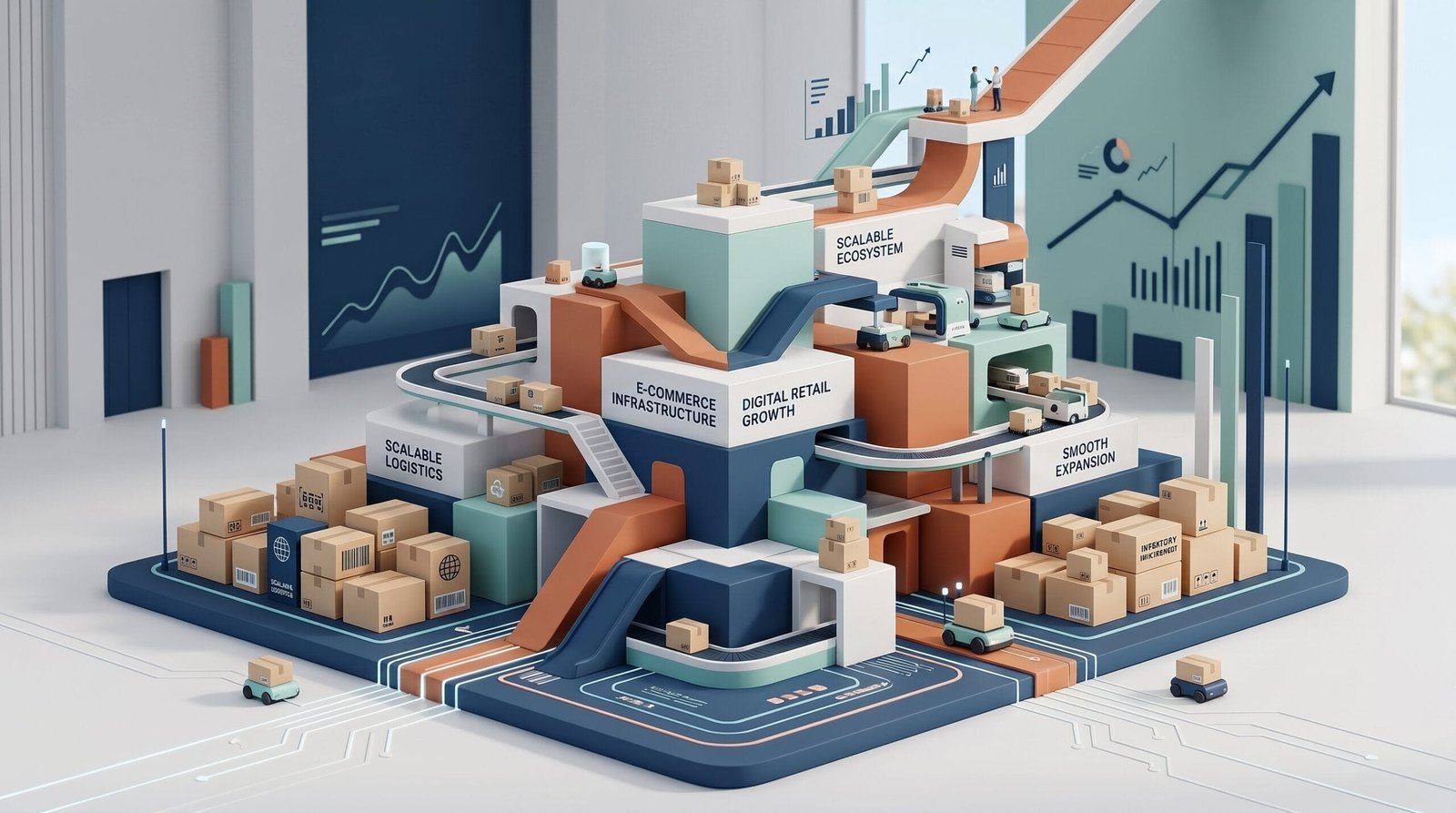
An online store can work perfectly well when it has a small product range, a moderate number of orders and relatively simple operations. The problems tend to appear when the business starts growing and processes that were once easy begin to generate manual work, errors and limitations.
More orders mean more information to manage. More products mean a more complex catalogue. And more customers demand a fast, reliable and consistent shopping experience.
That is why preparing an online store for growth is not simply about choosing a platform or adding more resources when problems appear. It means building a technological and operational foundation that can support the evolution of the business.
In this article, we look at the main areas to consider so that ecommerce growth does not eventually become a bottleneck.
What does it really mean to prepare an online store for growth?
An online store that is prepared for growth should be able to handle increased activity without every new order, product or customer requiring a complete change to the way the business operates.
This affects several areas: technology, product catalogue, inventory, orders, logistics, customer service, security, data analysis and marketing.
The goal is not to build an oversized solution from day one. That can create unnecessary costs. The objective is to make decisions that allow the store to expand without having to rebuild it when the business moves forward.
For example, a store with 50 products can usually be managed relatively easily. But if it later grows to 2,000 products, works with several suppliers and receives hundreds of orders, catalogue and inventory management can quickly become a significant source of problems.
Your product catalogue needs to be ready to scale
One of the first areas worth reviewing is how product information is organised.
When a catalogue is small, it is common to add and modify products manually. As the number of products increases, this approach consumes more time and increases the likelihood of errors.
A scalable catalogue structure should consider aspects such as:
- Categories and subcategories.
- Product attributes and variations.
- Internal references and product codes.
- Properly structured images and content.
- Prices and commercial rules.
- Inventory information.
- Data required for search engines and product filters.
It is also important to think about how new products will be added in the future. If every new product requires information to be entered manually across several systems, catalogue growth will eventually increase management costs.
Inventory and order management need to be reliable
One of the most common challenges when an ecommerce business grows is losing control over inventory.
An online store may initially manage stock directly through its administration system. However, once several warehouses, suppliers, sales channels or a higher volume of orders are involved, this approach can become insufficient.
It is important to define where inventory information comes from and which system should be considered the source of truth. You also need to establish how stock is updated when a sale, return or delivery of new products takes place.
The same applies to orders. A process that works perfectly with a few sales per day can become a considerable workload when order volumes increase.
The more automated the flow between order, payment, fulfilment, shipping and status updates, the less the business depends on manual tasks.
Your online store needs to handle more traffic
Ecommerce growth is not always gradual. An advertising campaign, promotion, media appearance or social media activity can suddenly generate a significant increase in traffic.
For this reason, performance should be considered from the beginning.
A slow website does more than damage the user experience. It can also affect conversion and make customer acquisition efforts less effective, as users have little patience when they experience problems browsing products or completing a purchase.
Preparing the infrastructure for growth means considering aspects such as hosting, server configuration, database performance, caching, image optimisation and the ability to respond to traffic peaks.
This does not mean choosing the most powerful infrastructure available from day one. It means having an architecture that allows capacity to be increased when it is actually needed.
Automate repetitive tasks before they become a problem
Many online stores start with manual processes because they are simple and inexpensive. The problem is that those same processes can become a significant workload as the business grows.
Copying information between systems, updating order statuses, sending certain notifications, preparing reports or manually checking inventory are examples of tasks that can consume many hours over the course of a month.
Before automating a process, it is useful to identify tasks that meet three conditions: they are repeated frequently, follow relatively clear rules and provide little additional value when performed manually.
Automation can be introduced progressively. There is no need to try to eliminate every manual task at once.
Integrations become more important as your business grows
An online store rarely operates completely on its own. Over time, businesses often introduce different systems to manage different parts of their operations.
For example, the store may need to connect with business management systems, marketing tools, logistics services, payment providers, customer service platforms or analytics solutions.
The problem appears when every integration is developed independently without considering the overall architecture.
Good planning should define which systems are involved, what information they exchange and which system is the source of each piece of data.
This reduces duplication and prevents situations where the same information is up to date in one system but outdated in another.
The shopping experience needs to scale too
Preparing an online store for growth is not only about internal processes. The customer experience must remain simple even as the business becomes more complex.
A large catalogue needs effective navigation. Customers should be able to find products quickly through appropriate categories, search functionality and filters.
The checkout process should also be reviewed regularly. The more products, promotions, delivery options or payment methods a store offers, the more complex the buying process can become.
The goal should be the opposite: more capability behind the scenes without transferring that complexity to the customer.
Security cannot be left until later
Growth also increases the importance of security.
An online store handles sensitive information relating to customers, orders, accounts and transactions. Security should therefore be considered part of the architecture and ongoing maintenance of the project.
It is important to keep the components being used up to date, control administrative access, maintain backups and have procedures in place to respond to incidents.
Furthermore, the more dependent the business is on its online store, the greater the potential impact of service interruptions. Business continuity should be part of the technology strategy.
Data needs to support growth
An online store can grow in traffic and sales without the business owner having a clear understanding of what is actually happening.
That is why it is important to define which indicators are genuinely needed to make decisions.
These may include metrics related to sales, conversion rate, average order value, customer acquisition, best-selling products, checkout abandonment or repeat purchases.
Technology should make this information easier to obtain, but it does not replace business judgement. Having more reports does not necessarily mean having better information.
It is usually more useful to have a smaller set of reliable and actionable indicators than to accumulate data that nobody uses.
When should you consider a technology upgrade?
There is no specific number of orders or products at which an online store needs to change its technology.
The need usually becomes clear when certain symptoms begin to appear:
- Manual tasks are consuming more and more time.
- Errors in orders or inventory are becoming frequent.
- The store experiences problems when traffic increases.
- Adding new products or categories becomes difficult.
- Business systems are not sharing information correctly.
- The checkout process requires too many steps.
- Every new feature requires an improvised solution.
- Maintenance is becoming increasingly complex and expensive.
When several of these problems occur at the same time, it may be more efficient to review the store's architecture rather than continuing to solve each issue separately.
Growth does not mean adding unlimited features
There is a tendency to assume that an online store prepared for growth needs more and more features. That is not necessarily the case.
The right technology is technology that solves the actual needs of the business while allowing it to evolve as those needs change.
Adding features that nobody uses can increase complexity, maintenance requirements and costs. On the other hand, a solution that is too limited may require major changes as the business grows.
Technology decisions should always be based on the business model, processes and objectives of the company.
How to prepare an online store for growth step by step
You do not need to address every issue at the same time. A progressive approach is often more practical.
- Analyse the current situation. Identify the store's limitations, manual processes and main friction points.
- Define future requirements. Consider how the catalogue, order volumes, sales channels and operations may evolve.
- Prioritise. Not every problem has the same impact. Start with the issues that directly affect sales, customers or efficiency.
- Review integrations. Determine which systems need to exchange information and how this can be done reliably.
- Automate progressively. Start with repetitive tasks that consume time and follow clear rules.
- Measure the results. Check whether the improvements actually reduce time, errors or costs and whether they improve the customer experience.
A scalable online store is an investment, not just a technical issue
The technology behind an ecommerce business should evolve alongside the business itself. An online store can work perfectly well today while accumulating limitations that will become obvious a few months later.
Preparing it for growth means anticipating those potential bottlenecks without overengineering the solution: organising information properly, automating processes, maintaining performance, connecting the necessary systems and keeping the shopping experience simple.
When these decisions are made carefully, growth becomes much easier to manage. The business can dedicate more resources to selling and less time to solving operational problems that could have been anticipated.
If you are planning a new online store or need to review your existing ecommerce operation before entering a new stage of growth, Orizontic develops ecommerce solutions adapted to the needs and objectives of each business. The first step is understanding how the company currently operates and what the store needs to be capable of handling in the future.