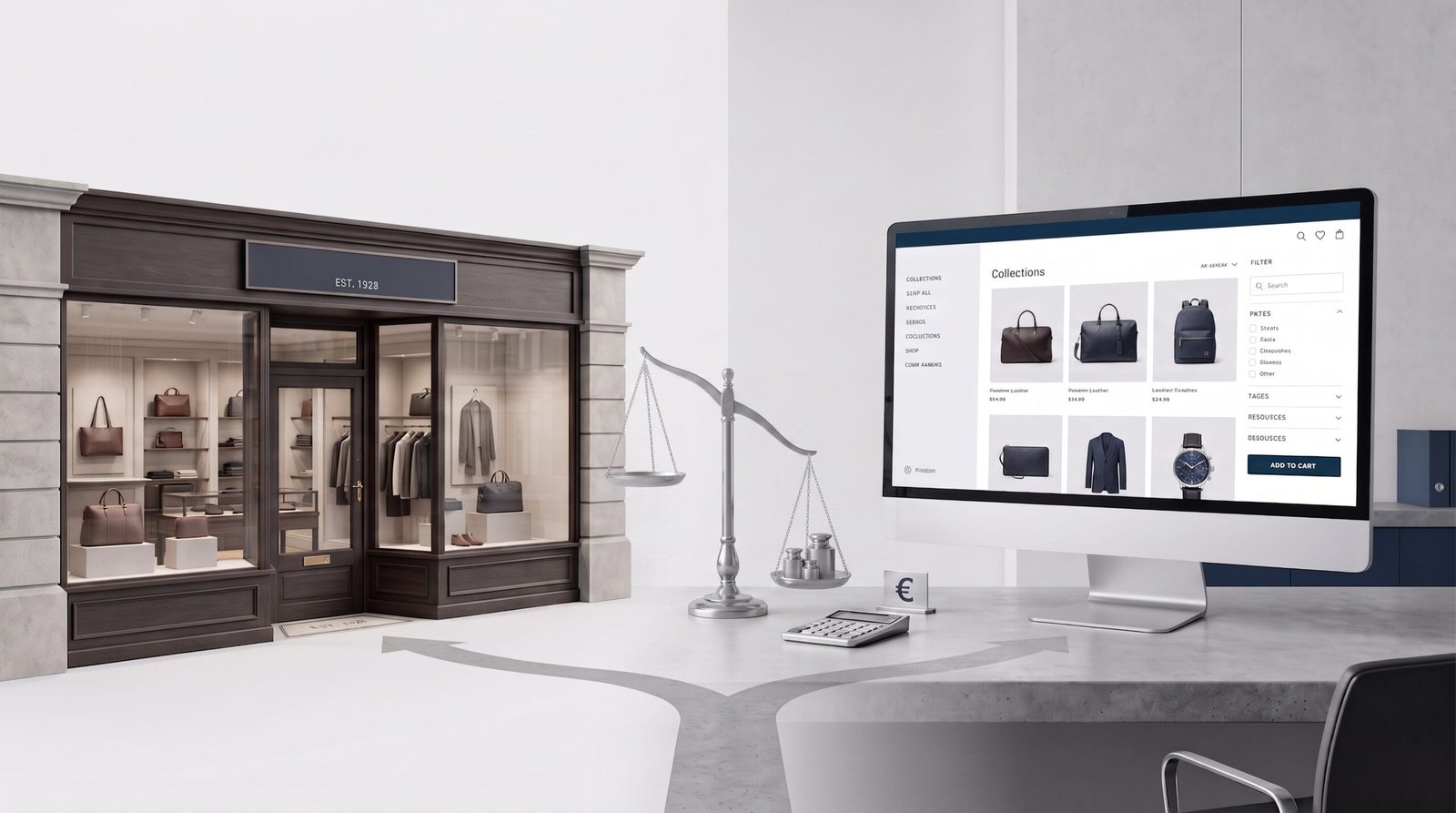
Not every business needs a custom ecommerce store. For many companies, a standard ecommerce platform can handle online sales perfectly well for years. The situation changes when the business starts relying on processes, integrations or customer experiences that the chosen platform cannot accommodate efficiently.
The decision should therefore not be framed simply as “standard store versus custom store”. It is a business decision: will the additional investment in a custom ecommerce solution create enough value to justify its greater complexity?
In this article, we look at when custom ecommerce development makes sense, the signs that it may be necessary, and the situations in which it is better to avoid unnecessary complexity.
What does a custom ecommerce store actually mean?
A custom ecommerce store is one whose functionality, design or architecture is developed specifically around a company's needs, rather than relying exclusively on the features and configuration options provided by a standard platform.
This does not necessarily mean building everything from scratch. A custom solution can use established technologies, platforms or third-party services while adapting the components that genuinely require a specific behaviour.
The important difference is the degree of adaptation. With a conventional ecommerce setup, the business often has to adapt to the possibilities offered by the platform to some extent. With a custom solution, the technology is designed around the company's processes and objectives.
When is a custom ecommerce store worth it?
There is no specific sales volume at which an ecommerce store automatically needs to become custom-built. The determining factor is usually business complexity, rather than revenue alone.
There are several situations in which a customised solution starts to make sense.
When the purchasing process is different from the standard model
A store selling straightforward products at fixed prices, with a conventional cart and online payment process, can often work very well with a standard ecommerce platform.
The situation is different when the purchasing process involves specific rules. For example, products may require configuration, personalised quotations, minimum quantities, customer-specific pricing, or several stages before an order can be confirmed.
Trying to reproduce these processes using numerous plugins, extensions and external solutions can eventually become more complicated than developing a specific functionality.
When pricing rules are complex
The price of a product is not always the same for every customer.
A manufacturer or distributor may work with different price lists depending on the customer, order volume, geographical area, commercial conditions or previously agreed terms. The business may also need cumulative discounts, volume-based pricing or specific rules for particular products.
If commercial logic is an important part of how the ecommerce operates, it is worth assessing whether the chosen platform can manage it natively or whether a custom development layer will be required.
When the ecommerce store needs deep integrations with other systems
An online store rarely operates completely in isolation. It may need to communicate with an ERP, CRM, warehouse management system, invoicing software, marketing tools or logistics services.
A single integration does not necessarily mean that the store needs to be custom-built. However, when ecommerce becomes a central component of the company's technology ecosystem, architecture and data exchange become much more important.
For example, an order may need to update stock automatically, generate information for the management system, apply a specific customer tariff, trigger a particular commercial action and return information to the customer. At that point, integration is no longer just an add-on.
When user experience is part of your value proposition
For some businesses, buying online is relatively straightforward. For others, the way customers discover, configure or select a product is a fundamental part of the value proposition.
An advanced product configurator, a personalised product journey or navigation designed around an unusually complex catalogue may require an interface that a conventional template cannot provide without substantial modifications.
In these cases, custom development can make it possible to design the technology around the customer experience the business actually needs, rather than forcing the buying journey into a predefined structure.
Signs that your current ecommerce store has outgrown its platform
Sometimes the need for a custom solution does not become apparent at the beginning of a project. It emerges after several years of growth and continuous changes. There are several warning signs worth monitoring.
- Every new feature requires several extensions or custom developments.
- Updates frequently create compatibility problems between different components.
- There are manual processes that should be automated.
- Ecommerce data and internal business systems are not properly synchronised.
- The sales team needs exceptions that the platform cannot handle.
- Performance has become an issue as the catalogue or traffic grows.
- The shopping experience is constrained by the platform's structure.
- Technology maintenance is consuming an increasing amount of internal or external resources.
One of these situations alone does not mean that the store needs to be rebuilt. The important question is how much the current limitations are costing the business and what alternatives are available.
Standard ecommerce or custom development: which option should you choose?
| Business situation | Solution that will often be the best fit |
|---|---|
| Simple catalogue and conventional purchasing process | Standard ecommerce platform |
| Business starting to sell online | Well-configured standard solution |
| Moderate customisation requirements | Standard platform with specific development |
| Complex commercial rules or internal processes | Highly customised solution |
| Critical integrations with business systems | Ecommerce architecture adapted to the business |
| Highly specific shopping experience | Partial or full custom development |
The comparison should not be reduced to the initial price. A standard platform may offer a simpler starting point, but some projects can accumulate costs through extensions, integrations, additional development and ongoing maintenance.
On the other hand, a custom solution normally requires greater initial investment and planning. It also requires a clear strategy for maintenance and future development.
Cost is not the only factor to consider
When comparing a standard ecommerce store with a custom solution, it is natural to focus on how much each one costs to develop. That is an important reference point, but it is not enough.
Opportunity cost also matters. If a technological limitation forces the team to perform manual tasks, slows down order processing or makes it harder to launch new products, there is a business cost even if it does not appear as a separate line on an invoice.
For this reason, it is more useful to assess the total cost of the solution over time: development, hosting, maintenance, updates, integrations, support and future modifications.
To understand the different elements that influence ecommerce investment, you can also read our guide to how much a professional online store costs.
Should you build from scratch or customise an existing platform?
“Custom” does not necessarily mean building an entirely new technology stack.
For many projects, a more sensible approach is to use an established technological foundation and develop only the parts that require specific behaviour. This makes it possible to take advantage of proven functionality while concentrating development effort where it creates real value.
The right choice depends on factors such as the business model, required integrations, catalogue size and complexity, internal processes, growth expectations and the resources available to maintain the solution.
Building everything from scratch can make sense in particularly complex scenarios, but doing so simply to obtain a solution that feels “more professional” is not sufficient justification.
Common mistakes when planning a custom ecommerce project
Developing functionality the business does not really need
Customisation makes sense when it solves a specific business need. Adding complexity because a feature seems technically interesting can increase costs and make maintenance harder without generating equivalent value.
Choosing the technology before defining the processes
Before deciding how to build an ecommerce store, it is important to understand how the company sells, how orders are managed, what information needs to be exchanged and what experience customers should have.
Technology should respond to those requirements, not the other way around.
Failing to plan for maintenance
An ecommerce project does not end when the store goes live. Updates, security, performance, integrations, functional improvements and new business requirements will continue to require attention.
A technically sophisticated solution that is difficult to maintain can become a problem over time.
Confusing customisation with complexity
A good custom ecommerce solution should not be complicated simply because it is customised. The objective is to make the technology solve the company's real requirements as clearly and efficiently as possible.
A practical way to decide whether you need a custom ecommerce store
Before starting development, it is useful to answer five questions:
- Which sales processes cannot be handled properly by a standard ecommerce platform?
- Which business systems need to integrate with the online store?
- Which pricing, ordering or catalogue rules are specific to the business?
- Which features will have a direct impact on sales, operational efficiency or customer experience?
- Does the company have the resources to maintain and evolve the solution over the long term?
If most of the answers point towards highly specific processes, critical integrations or a shopping experience that is difficult to accommodate within a conventional platform, it is worth evaluating custom ecommerce development.
If, on the other hand, the requirements are typical of a standard online store and there are no unusual technical or operational needs, it may be wiser to invest in configuration, design, SEO and commercial strategy before committing to an unnecessarily complex architecture.
The best ecommerce store is the one that fits the business
A custom ecommerce store is not automatically better than a standard solution. Its value depends on whether the customisation solves real problems and creates enough benefit to justify the additional investment.
For a small company with a straightforward catalogue, an established ecommerce platform may be the most efficient option. For a manufacturer with customer-specific pricing, business-system integrations and complex purchasing processes, the requirements may be very different.
The right decision therefore starts before discussing technologies: you need to understand the business model, processes and objectives of the ecommerce project.
At Orizontic, we work on ecommerce projects based on each company's specific requirements, with the aim of finding a sensible balance between functionality, investment, scalability and long-term maintenance.
If you are considering redesigning your ecommerce store or are unsure whether your project requires a custom solution, a proper requirements assessment can help you make the decision based on both business and technology criteria before committing to a larger investment.