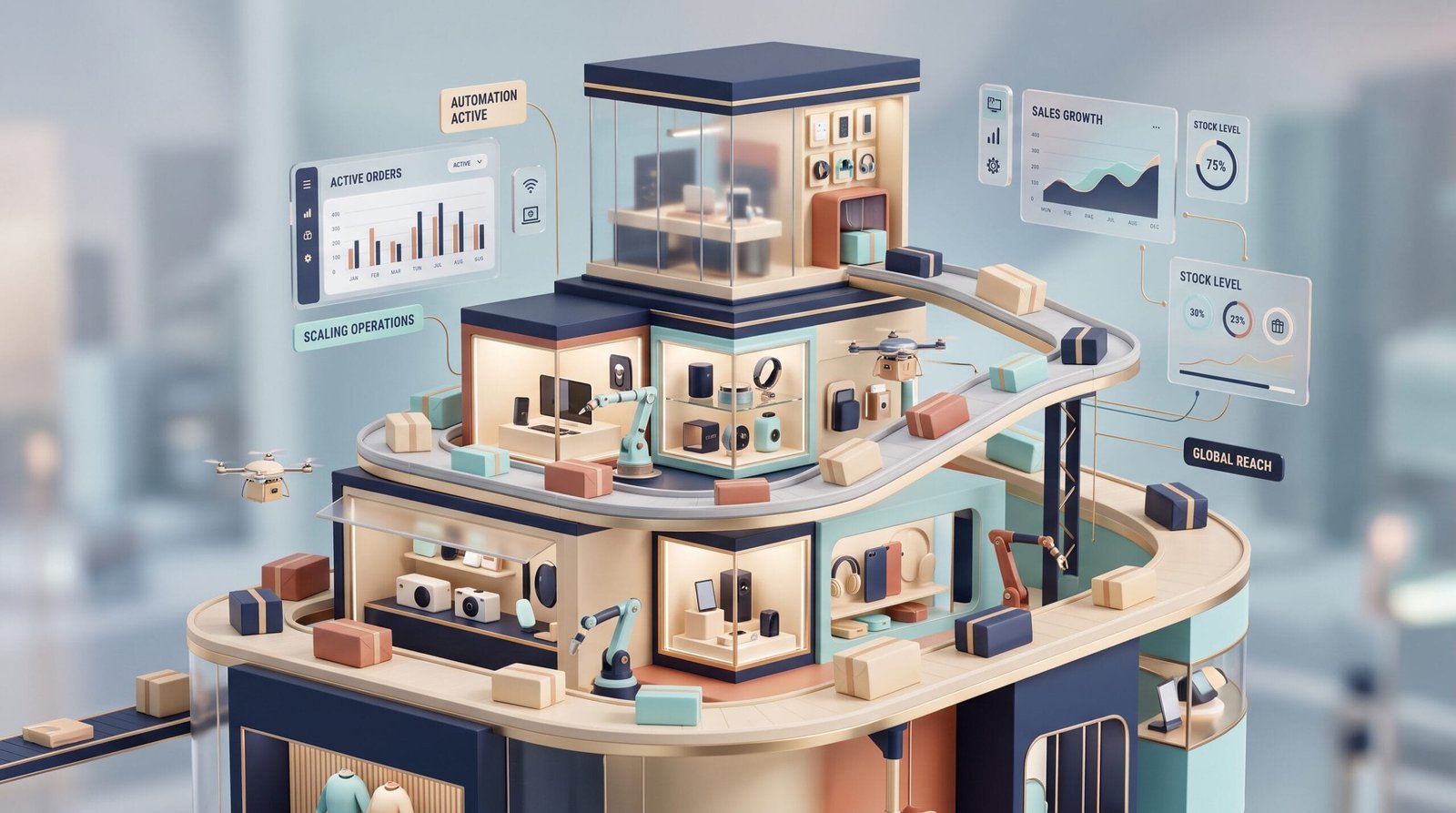
An online store can work perfectly well when it has a small product catalogue, a moderate number of orders and relatively simple management. The situation changes when the business starts to grow and tasks that were once easy to handle manually begin to consume significant amounts of time.
More orders mean more work. Stock needs to be managed, customers need attention, payments and deliveries need to be monitored, returns need to be processed and promotions need to be updated. If the store is not prepared for this growth, the team can end up spending too much time on tasks that could be automated.
Growing an ecommerce business is therefore not simply about selling more. It also means having a platform capable of handling that growth and adapting to new business requirements.
When does an online store need new features?
There is no specific number of orders or products that determines when an online store needs additional functionality. The need usually becomes apparent when managing the business starts to create problems or when certain processes are no longer sustainable.
Some common warning signs include:
- The team spends too much time entering information manually.
- Stock errors are becoming more frequent.
- Managing orders requires checking several different systems.
- Customers frequently ask for information that is difficult to provide quickly.
- The product catalogue is becoming increasingly large or complex.
- Managing promotions is becoming difficult.
- The same information has to be entered into different systems.
- The volume of orders is beginning to put pressure on daily operations.
When several of these situations occur, it may be time to review the ecommerce platform and consider which new features would have a real impact on the business.
1. Product management that can scale
A store with ten products can be managed very differently from one with hundreds or thousands of products.
As the catalogue grows, it becomes increasingly important to have tools that make it easier to create, edit and organise products.
Depending on the business, products may require variants, attributes, categories, images, technical documents, different prices or specific commercial rules.
It is also worth considering how this information will be updated. If every change has to be made manually in several places, the risk of errors increases.
A good product management system should allow the business to handle a larger catalogue without increasing the workload at the same rate.
2. Inventory and stock management
Stock control becomes particularly important as the number of orders increases.
Showing incorrect product availability can lead to customer service issues, cancelled orders and a poor shopping experience.
A growing ecommerce business may benefit from features such as:
- Automatic stock updates.
- Stock control by product and variant.
- Low-stock notifications.
- Out-of-stock product management.
- Tracking of stock movements.
- Integration with other business management systems.
If the business operates warehouses, physical stores or multiple distribution points, inventory management may require a more advanced approach.
3. Order automation
When only a few orders arrive each day, preparing each one manually may be perfectly manageable. As order volumes increase, the situation changes.
The ecommerce platform should make it possible for order information to reach the people or systems responsible for processing, preparing and shipping the order without unnecessary manual intervention.
Customer communications can also be automated, including order confirmations, status updates and delivery notifications.
The goal is not to automate everything simply because automation is possible. It is to reduce repetitive work and minimise the errors that tend to appear as workload increases.
4. Integration with other business systems
An online store does not necessarily need to operate as an isolated system.
As a business grows, it may need to connect its ecommerce platform with other tools used for areas such as accounting, logistics, customer service, marketing or general business management.
These integrations can prevent the same information from having to be entered several times.
For example, when an order is placed through the online store, relevant information can automatically be transferred to the system used to manage fulfilment and administration.
The right integrations depend on how each company operates. Before implementing them, it is worth analysing what information is generated, where it is used and which processes could be simplified.
5. Multiple payment methods
As an online store grows, its customer profile and target markets may also change.
This can create the need to offer different payment methods and adapt the checkout experience to the preferences of different markets.
Payment integrations should take into account factors such as security, user experience, error handling and payment reconciliation.
The checkout process should also remain clear and straightforward. A problem during payment can cause a customer to abandon a purchase that was almost complete.
6. Customer management
When a business has a small number of customers, many interactions can be handled manually. As the customer base grows, that approach becomes increasingly inefficient.
A growing online store may need a more structured way of managing customer information while complying with applicable data protection requirements.
Useful features may include:
- Order history.
- Customer accounts.
- Shipping and billing addresses.
- Customer segmentation.
- Management of returning customers.
- Access to relevant information for customer support.
The objective is to provide a more personalised experience without turning the management of every customer into a manual process.
7. More flexible pricing and promotions
Commercial requirements also tend to become more complex as an ecommerce business grows.
A store may move from having a single price for each product to managing discounts, temporary promotions, promotional codes, volume-based conditions or different commercial rules.
The platform should make it possible to manage these situations without requiring constant changes to the underlying code.
The more flexible the commercial management system is, the easier it becomes to test different sales strategies without depending on technical changes for every new campaign.
8. Search and advanced filtering
Search functionality becomes increasingly important as the product catalogue grows.
When a store has only a few products, browsing categories may be enough. With hundreds of products, finding the right item can become much more difficult.
A good search system should help customers find what they are looking for even when they do not use the exact product name.
Filters can also be particularly useful for large catalogues. Depending on the sector, customers may need to filter products by price, characteristics, availability, size, brand, application or other relevant attributes.
9. Customer account area
An online store with a growing number of returning customers can benefit from a well-designed customer account area.
Customers should be able to access relevant information without having to contact the company every time they have a question about their account or an order.
Depending on the business, the customer area may include:
- Order history.
- Order status.
- Invoices or related documents.
- Saved addresses.
- Personal information.
- Return options where applicable.
This gives customers greater autonomy and can reduce part of the workload handled by customer support.
10. Automated customer communications
A growing online store generates a large number of customer communications: orders received, payments confirmed, shipments, incidents, returns and other interactions.
Automating these communications makes it possible to keep customers informed without requiring the team to intervene manually in every order.
However, automation should not mean sending more messages. The objective is to provide the right information at the right time.
11. Analytics for better decision-making
The larger an ecommerce business becomes, the more important it is to understand what is working and what is not.
Revenue alone does not provide enough information. It can be useful to analyse the business from several different perspectives.
For example:
- Best-selling products.
- Products receiving many visits but few purchases.
- Average order value.
- New and returning customers.
- Sales by channel.
- Campaign performance.
- Cart abandonment.
- Conversion by device.
Reliable measurement helps businesses make decisions based on evidence rather than assumptions.
12. Preparing the store for new markets
Growth may eventually lead a company to sell outside its original market.
At that point, new requirements can appear around languages, currencies, taxes, payment methods, logistics and commercial conditions.
If international expansion is part of the business strategy, these requirements should be considered when planning the ecommerce solution.
This does not mean that every online store needs every international feature from day one. It means that the underlying architecture should, where possible, avoid forcing the business to rebuild the entire platform when it decides to expand.
13. Security and access control
Growth also means that the platform handles more information, users and transactions.
For this reason, security should be part of the ecommerce strategy rather than treated as a secondary technical issue.
Depending on the size and characteristics of the business, different access levels may be required for the people managing the online store.
Not every employee needs access to the same information or the same administrative functions.
It is also important to keep systems updated, monitor access and have appropriate backup and recovery mechanisms in place.
Do you need all these features from the beginning?
Not necessarily. In fact, trying to build an online store with every possible feature from day one can be counterproductive.
Technology should respond to genuine business needs. A feature that does not provide real value can add complexity, increase maintenance requirements and create additional points of failure.
A more sensible approach is to identify what the business needs today while considering the requirements that are likely to appear as it grows.
This makes it possible to build a solution that can evolve progressively rather than having to be replaced every time the business reaches a new stage.
The goal is not more features, but better processes
It is easy to assume that a professional online store is one with the greatest number of features. That is not necessarily the case.
A feature makes sense when it solves a specific business problem or clearly improves the customer experience.
For example, automating stock updates can reduce manual work. A better search function can help customers navigate a large catalogue. An integration with another business system can prevent errors caused by entering the same information more than once.
The better question is not “What features should my online store have?” but “Which processes are currently limiting my business growth?”.
How to decide which features your ecommerce business needs
Before developing new features, it is worth analysing the current situation and prioritising the areas where technology can have the greatest impact.
- Identify the problems: find the tasks that consume the most time or generate the most errors.
- Assess the impact: determine which problems directly affect sales, costs or customer experience.
- Prioritise: not every improvement has the same business value.
- Review integrations: identify which systems need to exchange information.
- Plan for growth: consider the requirements that are likely to appear if the business continues to expand.
- Measure the results: after implementing an improvement, check whether it has actually solved the original problem.
This approach helps businesses invest in ecommerce technology more rationally and avoid developing features simply because they seem interesting.
Conclusion
When an online store starts to grow, the needs of the business change. Processes that worked perfectly with a small catalogue and a limited number of orders can become bottlenecks as activity increases.
Product management, inventory, order automation, integrations, payments, customer management, promotions, analytics and security are some of the areas that may become increasingly important as an ecommerce business grows.
There is no universal list of features that every online store needs. The right solution depends on the business model, catalogue, internal processes, customers and growth objectives.
If your ecommerce business is growing and you need to assess which technological improvements could help you manage it more efficiently, Orizontic can help you analyse your requirements and define an appropriate solution. Discover more about our ecommerce development services.
The best ecommerce technology is not the one with the most features. It is the technology that allows the business to grow without making day-to-day management unnecessarily complicated.