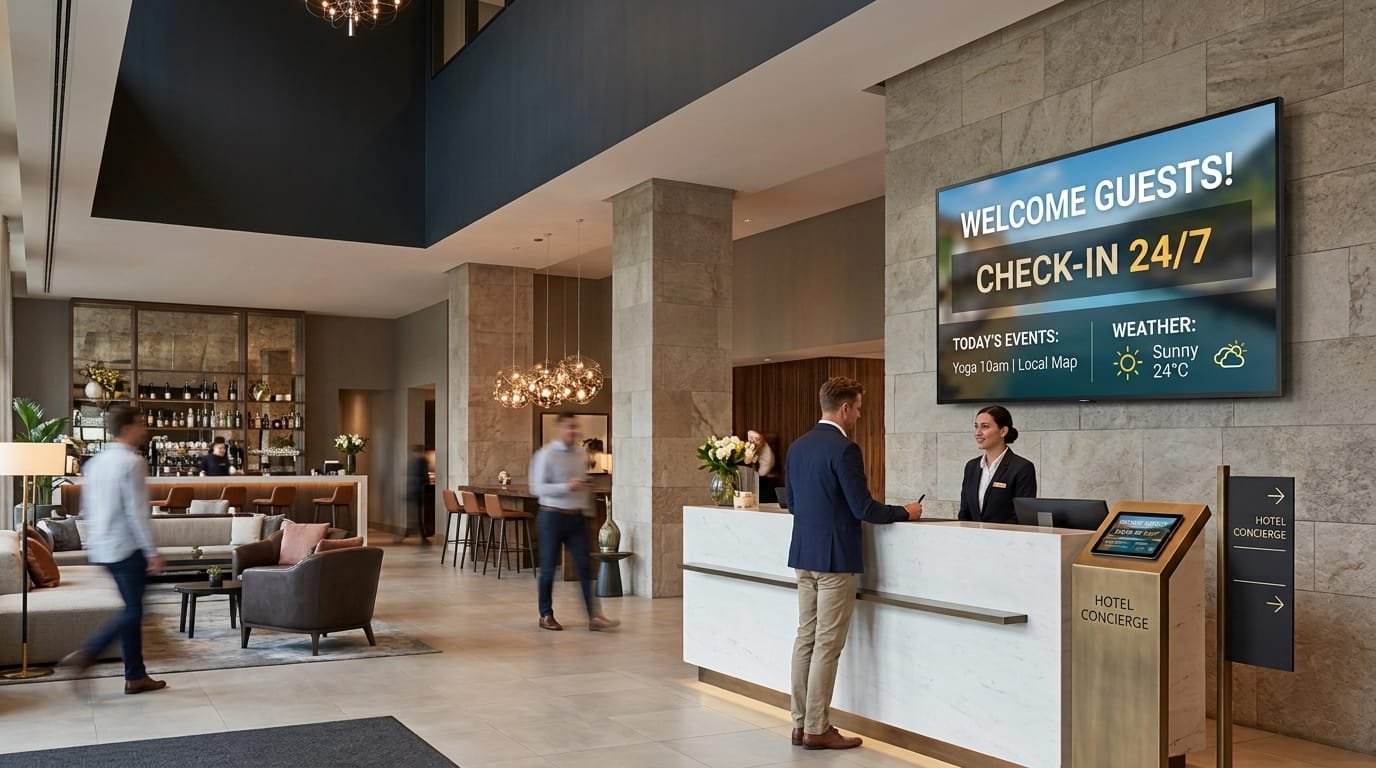
A hotel guest's experience is made up of many different moments: arrival, check-in, moving around the property, accessing services, dining and departure. At each stage, guests may need to find information quickly.
Digital signage for hotels allows screens to be used as communication points throughout the property. They can display information about services, opening hours, events, promotions, directions or specific messages without relying entirely on printed signs.
However, simply placing screens throughout a hotel does not guarantee better communication. The value of a digital signage solution depends on where the screens are installed, what information they display, how the content is updated and how the system fits into the hotel's day-to-day operations.
For this reason, before choosing screen models or designing visual content, it is worth analysing which specific needs the technology can solve.
What can digital signage be used for in a hotel?
A hotel can have different communication needs depending on the area. The information a guest needs at reception is not necessarily the same as what may be useful in a lift, meeting room or restaurant.
This variety means digital signage can have very different applications within the same property.
Service and opening hours information
Screens can be used to communicate opening hours for hotel services, restaurant information, breakfast times, gym, spa, pool or other facilities.
This information may change depending on the season, day of the week or specific circumstances. Having a system that allows it to be updated without replacing physical materials can simplify management.
Directions around the hotel
In larger properties, helping guests find their way can be an important task. A screen can help indicate where specific facilities are located or how to reach a particular room or meeting area.
In this context, digital signage does not necessarily need to be visually striking. Its primary function is to make navigation easier and reduce uncertainty during the guest journey.
Events and meetings
Hotels with meeting rooms, conference spaces or event facilities can use screens to display information about specific activities.
For example, a screen located near several meeting rooms can indicate which event is taking place in each space and at what time. If the schedule changes, the content can be updated without physically changing the signage.
Promotions and additional services
Digital signage can also be used to communicate services that guests may want to use during their stay.
Dining, treatments, activities, experiences, event services or other offerings can all be included in the hotel's communication strategy.
The information should be relevant and displayed in the right location. Showing a restaurant promotion in a place where a guest is trying to find their room may be less useful than presenting that information near the relevant service area.
Communication at reception
Reception is one of the main points of interaction between guests and the hotel. Screens can complement the information provided by staff with messages about services, opening hours or relevant events.
The goal should not be to replace personal assistance, but to make information available in a format that guests can consult quickly.
Hotel screens can have different functions depending on the location
One common mistake is to treat every screen as if it had the same purpose. Its location determines what type of content makes sense.
| Area | Possible uses |
|---|---|
| Reception | General information, services, opening hours and welcome messages. |
| Lobby | Events, promotions, hotel information and directions. |
| Lifts and corridors | Directions, services and short communications. |
| Meeting rooms | Events, schedules, participants and activity locations. |
| Restaurants and cafés | Menus, promotions, products and opening hours. |
| Leisure areas | Activities, schedules and available services. |
This approach makes it possible to build a content strategy based on context. A screen does not need to display everything the hotel wants to communicate, but rather the information that is most useful to the people standing in front of it.
What benefits can digital signage provide for hotels?
The value of digital signage depends on how it is used, but there are several advantages that can be particularly relevant for properties with changing information or multiple communication areas.
Updating information without replacing physical signage
When opening hours, activities or services change, updating digital content can be simpler than preparing new printed materials.
This is especially useful when the hotel needs to make frequent changes or communicate temporary information.
Scheduling content
A digital signage platform can allow businesses to schedule which content should appear at specific times.
For example, a screen can display breakfast information in the morning and switch later to communicate other services. Content can be prepared in advance and the system can change it according to the established schedule.
Managing multiple screens centrally
In a hotel with multiple screens, updating every device individually can quickly become impractical.
Centralised management allows the hotel to organise content and decide what should appear at each location. It also makes general changes easier when information applies throughout the property.
Adapting communication to each location
Guests do not need the same information everywhere.
A screen near a meeting room can focus on events. A screen in a restaurant can display dining information. A reception screen can provide general messages.
This segmentation prevents the system from becoming a generic information display with little relevance to the specific context.
Digital signage for hotels and the guest experience
Communication has a direct relationship with the guest experience. Information displayed in the right place and at the right time can make it easier for guests to complete an action that might otherwise require asking staff or searching for information elsewhere.
For example, a screen can clearly indicate where an event is taking place or communicate the opening hours of a facility. These may seem like small details, but they form part of the overall operation of the property.
The screen should act as a support tool. If guests have to stop for too long, interpret unclear messages or search through too much information, its usefulness decreases.
For this reason, content design should start with a simple question: what does someone standing in this particular area of the hotel need to know?
Can digital signage replace traditional hotel signage?
Not necessarily. In many hotels, the most effective solution may combine digital signage with physical signs.
Traditional signage can still be appropriate for permanent directions or information that rarely changes and that guests need to identify immediately. For example, certain safety signs or permanent directions may not require a screen.
Digital signage is more useful when the content is dynamic, temporary, changes according to the time or requires centralised management.
The question should not be how to digitise every sign in the hotel, but which information genuinely benefits from a digital format.
How does a digital signage system for hotels work?
Behind a digital signage screen there is usually a combination of hardware, software and connectivity.
Displays
Screens should be selected according to their location and purpose. A display installed in an indoor lobby does not necessarily require the same characteristics as one placed in an area with strong natural light.
Size, orientation, viewing distance and environmental conditions should also be considered.
Media players and devices
Depending on the solution, a device connected to each screen may be used to play content delivered by the management platform.
The exact configuration will depend on the system selected and the hotel's requirements.
Content management software
The software allows businesses to organise content, create schedules and manage different screens.
This is particularly important when the property has multiple communication points, as it centralises tasks that would otherwise have to be performed screen by screen.
Connectivity
Screens need some form of communication with the management system. The hotel's existing infrastructure will influence the technical solution.
It is also important to consider what happens when a screen temporarily loses connectivity. A properly designed solution should be able to continue displaying available content and synchronise again once communication is restored.
Digital signage for hotels and event management
Hotels with meeting, conference or event spaces can find digital signage particularly useful for managing event communication.
The same installation can be used to communicate different activities throughout the day. For example, a screen could display information about a business meeting in the morning and later change to indicate the location of a presentation or private event.
If the hotel has several rooms, information can be distributed differently depending on the location.
This requires well-organised content management. Having screens is not enough: someone needs to prepare the information, check that it is correct and update it when the schedule changes.
Can digital signage be integrated with other hotel systems?
In certain projects, yes. Integration can allow digital signage to use information from other systems within the property.
For example, a solution could be built around event information, services, schedules or certain internal data, provided the systems involved support the required integration.
The value of these connections increases when there is a large amount of information or when updates are frequent. If a hotel only needs to update a few screens manually from time to time, a complex integration may not provide enough value.
Before connecting systems, it is worth analysing what information is required, where it is currently stored and which process needs to be improved. Technology should solve a specific need rather than add complexity without a clear purpose.
Common mistakes when installing screens in a hotel
Installing screens without defining objectives
Buying equipment before deciding what purpose it will serve can result in an installation that is only used to a limited extent.
It is better to define communication needs first and then determine which technology is actually required.
Displaying too much information
A screen located in a busy area has very little time to capture attention. If it contains too many messages, guests may not identify any of them.
Information should be adapted to the time available for reading and to the specific purpose of the screen.
Using the same content throughout the hotel
Centralised management does not mean that every screen has to display the same content.
A well-designed system can use general communication for certain messages while showing specific content in each area.
Failing to assign responsibilities
Content management needs clear ownership. Someone should be responsible for reviewing opening hours, events, promotions and other messages before they appear on screens.
It is also useful to establish a process for last-minute changes.
Neglecting technical maintenance
A screen that is not working correctly can affect the guest experience and leave part of the planned communication unavailable.
For this reason, maintenance of the devices, connectivity and software should be considered part of the project from the beginning.
How to plan a digital signage project for a hotel
The best way to start is to analyse the property before selecting the equipment.
- Identify communication points: locate the areas where guests need information.
- Define the purpose of each screen: decide whether its role is to inform, guide, promote or support a specific service.
- Classify the content: separate permanent information, temporary content and campaigns.
- Analyse update frequency: determine which information changes and how often.
- Review the technology infrastructure: check connectivity, power supply, placement and environmental conditions.
- Define content management: establish who prepares, reviews and schedules the content.
- Consider future requirements: if the hotel may add screens or communication areas, the solution should be able to evolve with the project.
This approach helps avoid an installation based solely on the number of screens. What matters is that every device has a clear function within the guest experience and the hotel's operations.
When does digital signage make sense for a hotel?
Digital signage can be particularly useful in hotels with multiple services, several communication areas, frequent events or information that changes throughout the day.
It can also provide value when the property operates several locations and needs to maintain consistent communication without updating every screen independently.
For a small hotel with few services and very stable content, a simple solution may be sufficient. Not every signage requirement justifies a digital infrastructure.
The principle should remain the same: identify the problem first and then determine whether a screen and content management system can solve it in a practical way.
Beyond the screens: why content management matters
One aspect that is easily overlooked is day-to-day management. The technology may work perfectly and still provide limited value if content is outdated or does not reflect the hotel's actual needs.
For this reason, the project should define from the beginning who prepares the content, how often it is reviewed, how urgent changes are handled and what happens when a screen stops working.
For hotels with multiple locations, this organisation becomes even more important. Centralised technology can simplify management, but it still requires clear processes behind it.
A digital signage solution adapted to the hotel
Digital signage can become a useful tool for improving hotel communication, provided the solution is designed around the property's actual requirements.
Before choosing screens, it is worth analysing the spaces, content, existing systems and the way staff will manage the information. More complex projects may also require integrations or custom functionality.
At Orizontic, we can help you analyse these requirements and assess how a digital signage solution could fit into your hotel's technology infrastructure. You can learn more about our technology consulting services or explore custom software development for projects that require specific functionality.
The goal should not be to install screens throughout the property, but to use technology where it can genuinely make information easier to access and communication easier to manage.