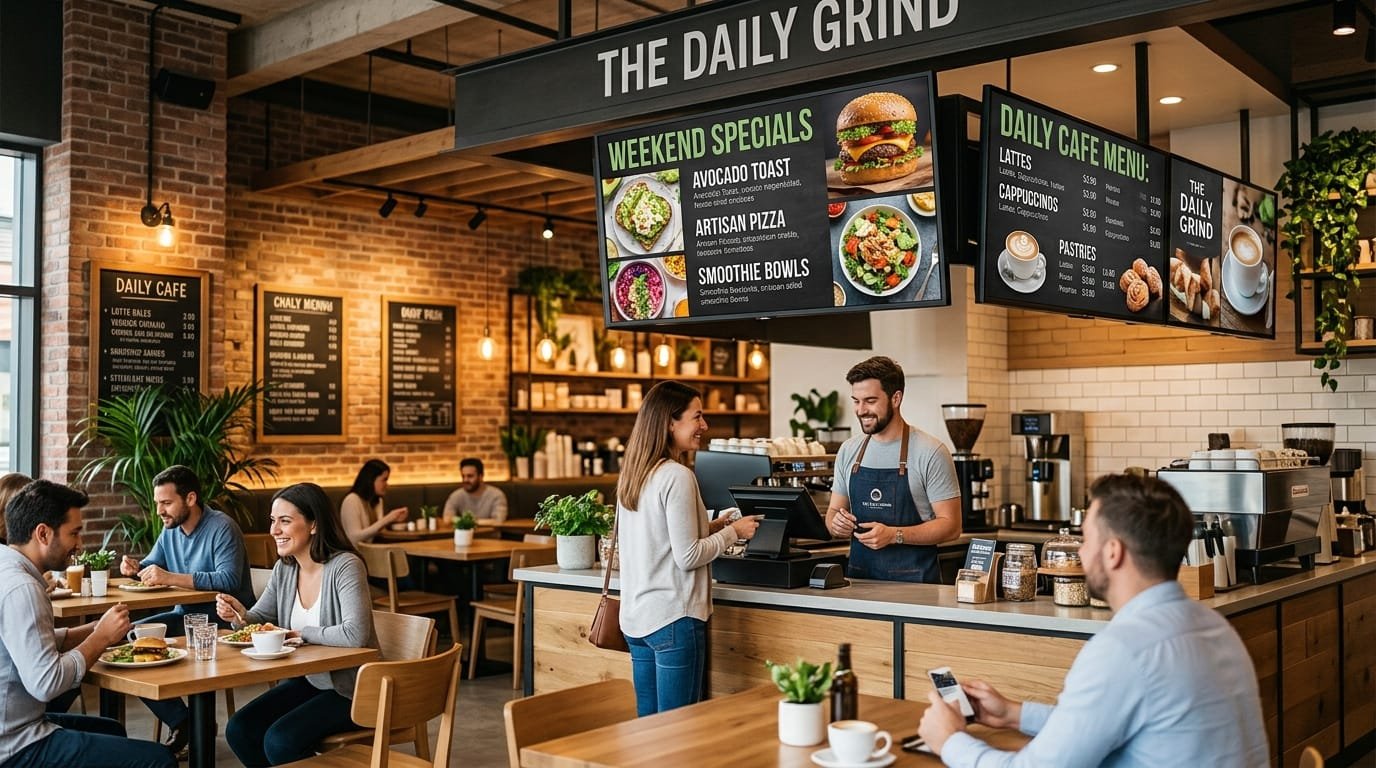
Digital signage for restaurants and cafés can change the way a business presents its offering. A screen can be used to update a menu, highlight a product, communicate a promotion or adapt content throughout the day without constantly replacing printed materials.
However, the value of this technology is not simply about replacing a printed menu with a screen. In hospitality, where opening hours, product availability and customer behaviour can vary throughout the day, having content that can be managed and updated easily can serve a practical purpose.
The question is how to use it effectively. A poorly planned screen can become another element to maintain, while a well-designed solution can simplify certain tasks and improve communication with customers.
What can digital signage be used for in a restaurant?
The possibilities depend on the type of establishment, its layout and the experience it wants to provide. A small café does not necessarily need the same solution as a restaurant with several locations or a larger hospitality business.
Some of the most common applications involve presenting the menu, promoting specific products and providing information customers need before or during their visit.
Displaying the menu and daily offerings
One of the most obvious uses is displaying the menu, selected products or offers available at a particular time.
For example, a café can display breakfast options in the morning and later change the content to highlight other products. A quick-service restaurant can use screens to present meal combinations or draw attention to specific menu options.
The advantage compared with static signage becomes clear when the offering changes frequently. Content can be updated without printing new materials and distributing them around the premises.
Promotions and featured products
Screens can also be used to give greater visibility to specific products or campaigns.
A restaurant might highlight a seasonal dish, a new menu item or a specific promotion. A café could use the same space to promote products that complement a customer's usual order.
However, it is worth avoiding turning the screen into an endless sequence of promotions. The content should be relevant to the time of day and to what customers can actually purchase.
Communicating information while customers wait
In some establishments, customers may have to wait to be served, collect an order or be seated.
Digital signage can make use of this time to display useful information, explain services, showcase products or communicate specific messages from the business.
This does not mean that every waiting period needs to be filled with advertising. Simple and relevant content may be more appropriate than a constant stream of offers.
Promoting additional services
Screens can also communicate services that customers may not be aware of.
For example, a restaurant could provide information about takeaway orders, reservations, event services, catering or specific contact channels.
The screen therefore becomes an additional information point within the customer journey.
Digital signage for restaurants: interior, counter and shop window
The location of the screens influences both the content and the purpose of the communication.
Shop window
A screen facing the outside has mainly an attention-grabbing role. The content should be understandable within a few seconds and remain visible from a certain distance.
It can be used to highlight a product, promotion or specific offering. If the message requires too much time to understand, it is probably not suitable for that location.
Ordering area
In restaurants and cafés where customers order at a counter, screens can make it easier to present the available offering.
In this situation, information organisation becomes particularly important. Customers need to find products, prices and available options quickly.
The design should help customers make a decision rather than make it more difficult by displaying too many visual elements at once.
Inside the establishment
Indoor screens can serve a different purpose. Customers may spend more time looking at them, providing greater flexibility for informational or audiovisual content.
They can also be used to reinforce the restaurant's visual identity or create different types of communication in different areas of the premises.
What benefits can digital signage provide in hospitality?
The main benefit depends on how the system is used. For some businesses, it may be the ease of updating content; for others, it may be the ability to manage several locations from a single system.
Easier content updates
When a restaurant frequently changes its offering, being able to modify certain content digitally can simplify management.
This can be useful for daily menus, seasonal products, temporary promotions or messages that only need to be displayed for a limited period.
Scheduling content according to opening hours
One of the most useful possibilities is scheduling different content for different times of day.
A café could display breakfast options in the morning, other products later in the day and a specific campaign during selected hours. Scheduling removes the need to make every change manually.
Content can also be prepared in advance and configured to appear automatically at the appropriate time.
Managing multiple locations
For businesses with several locations, centralised management can be one of the strongest reasons to use digital signage.
A campaign can be distributed to different establishments without updating each screen individually. At the same time, specific content can be adapted to each location.
This makes it possible to combine consistent brand communication with information that is relevant to each restaurant or café.
Reducing some of the work associated with physical materials
When a business regularly changes promotions, menus or messages, preparing, printing, transporting and replacing physical materials can become a recurring task.
Digital signage does not eliminate all of this work, but it can reduce certain tasks related to replacing physical content.
How does a digital signage solution for hospitality work?
Although customers only see a screen, a digital signage system usually involves a small technology infrastructure behind it.
Display
The display is the visible element and should be selected according to where it will be installed.
Size, brightness, orientation and environmental conditions can all influence the choice. A screen installed near a window may require different characteristics from one located in an interior area.
Media player
Depending on the solution, a device connected to the screen may be responsible for receiving and playing the content.
This component separates the physical display from the system responsible for managing the information.
Content management platform
The management software allows businesses to prepare content, organise playlists, schedule changes and control different screens.
For an establishment with multiple screens, centralised management avoids having to update each device individually.
Connectivity
The solution requires some form of communication to receive content or synchronise with the management platform.
It is also important to consider what happens when connectivity is temporarily interrupted. The system should be able to continue displaying available content and restore synchronisation afterwards.
Can digital signage be connected to other restaurant systems?
Yes. In more advanced projects, digital signage can be integrated with other business systems.
For example, certain content could depend on information managed by other applications. This can be useful when a business has a large product catalogue, several locations or information that changes frequently.
Integration can also automate part of the process of updating certain content, provided the necessary information is available and the underlying architecture supports it.
However, it is not always worth connecting every system. If a small café has a limited offering that only changes occasionally, a simple content management solution may be enough. Integration becomes more valuable when it solves a recurring task or reduces a specific operational problem.
A practical example: a café with different dayparts
Imagine a café with different offerings throughout the day.
In the morning, it may want to highlight breakfast options and coffee. At lunchtime, it could promote selected food choices. In the afternoon, the content could change to feature snacks or other products.
With traditional signage, every change would require new materials to be prepared and replaced. With a digital solution, the content can be prepared in advance and scheduled to appear automatically.
This does not mean that the screen will automatically increase sales. Its value lies in making an existing communication strategy easier to manage and adapt.
Common mistakes to avoid
Using screens as simple televisions
A screen that remains switched on throughout the day does not necessarily constitute an effective digital signage strategy.
Without content planning, scheduling and maintenance, the technology may end up being used only to a very limited extent.
Displaying too many products at once
A digital menu should not attempt to reproduce an entire physical menu on a single screen if doing so makes it difficult to read.
Information should be organised according to the screen's purpose and the amount of time customers have to consult it.
Failing to update promotions
One of the most obvious problems with any content system is allowing information that is no longer valid to remain visible.
An expired promotion or unavailable product can create confusion and force staff to provide explanations.
Not defining who manages the system
There should be a person or team responsible for reviewing and updating content.
It is also useful to establish a process for temporary campaigns, changes to the offering and exceptional situations.
Neglecting the technical side
Screens and media players require maintenance. Connectivity, content playback and the overall operation of the system should also be checked regularly.
When several locations are involved, this becomes even more important because a technical issue can affect more than one establishment.
How to get started with digital signage in a restaurant or café
There is no need to begin with a complex installation. In fact, analysing the actual needs first can prevent an investment that becomes difficult to justify later.
- Define what you want to communicate: identify whether the priority is menus, promotions, products, information or a combination of different types of content.
- Analyse the customer journey: determine where each type of information makes the most sense.
- Assess how frequently content changes: the more dynamic the content, the greater the potential value of digital management.
- Decide who will manage the content: establish responsibilities before putting the system into operation.
- Review the infrastructure: check connectivity, screen placement, power supply and environmental conditions.
- Consider future growth: if there is a possibility of opening more locations or adding more screens, take this into account when designing the initial solution.
This last point is important. A solution that works well for a single café may become insufficient when the business adds new locations.
When does digital signage make sense for a restaurant or café?
Digital signage can make sense when content changes frequently, there are different dayparts, the business operates multiple locations or there is a need to update communication centrally.
It can also be useful for businesses that run frequent campaigns and want to reduce some of the work associated with printed materials.
On the other hand, a small establishment with a very stable offering may not need sophisticated infrastructure. In that situation, a simple solution may be enough, or traditional signage may still be the more appropriate option for certain types of information.
The technology should respond to the needs of the business rather than the other way around.
Digital signage and the customer experience
In hospitality, communication is part of the overall customer experience. Customers need to find information quickly, understand the offering and make decisions without the signage becoming an obstacle.
For this reason, a screen should fit naturally into the way the establishment operates. Its location, size, content and update frequency should be planned according to how the space is actually used.
It is also worth remembering that not everything needs to move. Constant animation does not necessarily provide more information. In many situations, a clear design that remains visible for several seconds can be more useful than a rapid succession of messages.
A digital signage solution should adapt to the establishment
Digital signage can be a simple solution for managing specific content or become a more sophisticated system when a business has multiple locations, numerous screens and integrations with other tools.
The difference comes from designing the solution around the actual needs of the business. Before deciding which screens to install, it is worth analysing the content, management processes, existing infrastructure and possible future development of the project.
At Orizontic, we can help you analyse these needs and assess how a digital solution could fit into your business's technology infrastructure. You can learn more about our technology consulting services or explore custom software development when the project requires specific functionality.
The goal should not be to fill the establishment with screens, but to use technology where it can genuinely simplify management and improve communication with customers.