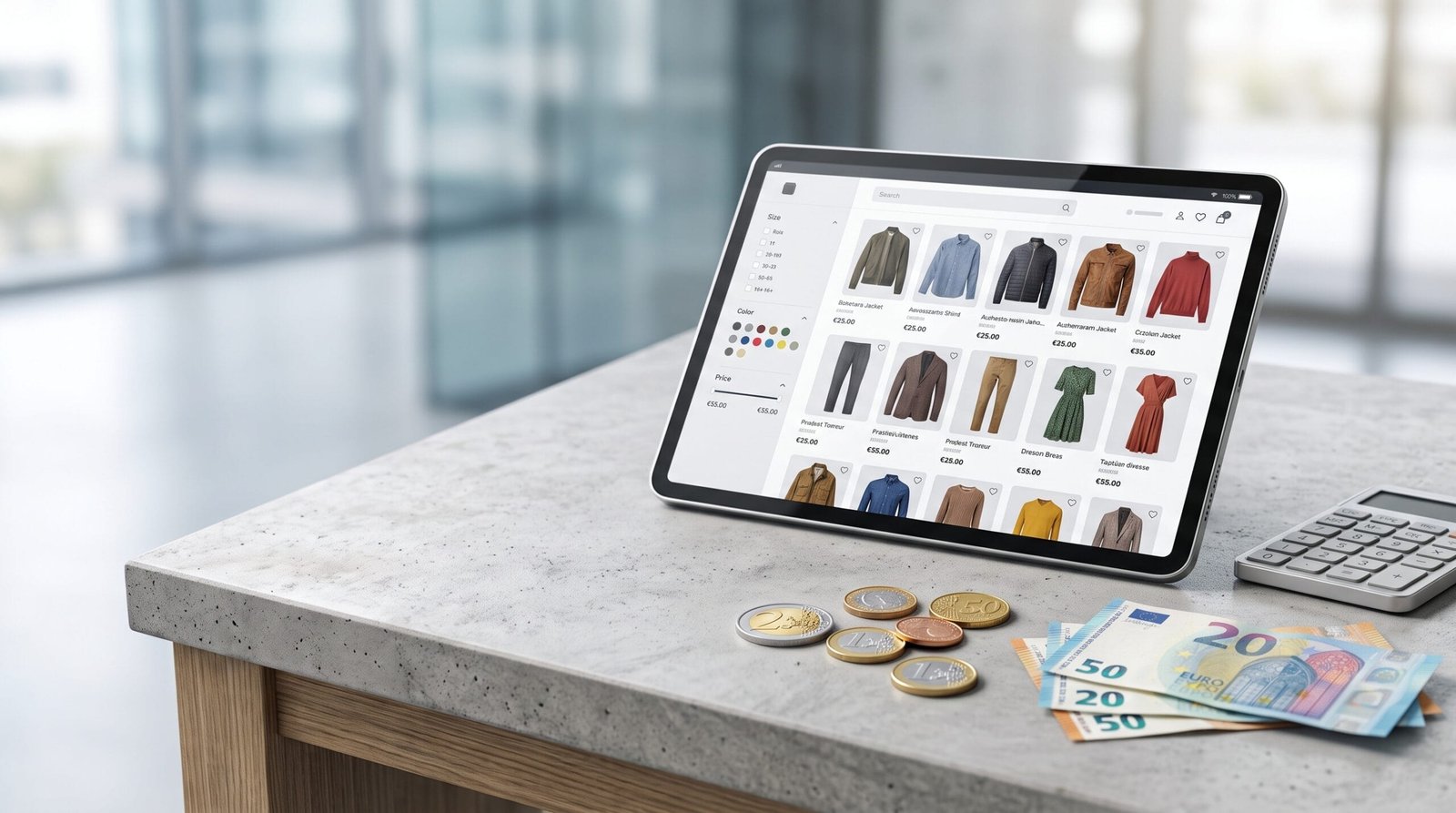
Asking how much a professional online store costs seems like a straightforward question, but the answer depends on something more important than the technology you choose: what your business actually needs to sell online.
Launching a simple store with a small product catalogue is very different from developing an ecommerce platform connected to an ERP, with multiple payment methods, advanced stock management, several languages and automated processes.
The initial development budget is also only part of the investment. A professional online store involves other costs such as the domain, hosting or ecommerce platform, design, development, maintenance, tools, payment processing, SEO and customer acquisition.
In this article, we look at each of these costs to understand how much it really costs to create and maintain a professional online store.
How Much Does a Professional Online Store Cost?
As a general reference, a professional online store can require an initial investment of a few thousand euros for relatively simple projects, while more advanced ecommerce platforms can require tens of thousands of euros or more when they involve custom design, development, integrations and complex functionality.
There is no standard price because the cost depends mainly on the scope of the project. An online store based on a standard ecommerce solution will have a very different cost structure from a highly customised platform developed specifically for a company.
| Type of online store | Typical initial investment | Typical business profile |
|---|---|---|
| Simple online store | From a few thousand euros | Small business with a limited catalogue and standard requirements |
| Professional ecommerce store | Several thousand euros | Business requiring customised design, SEO, integrations and a well-designed shopping experience |
| Advanced ecommerce platform | Tens of thousands of euros or more | Business with ERP integration, automation, multiple markets, complex catalogues or customised processes |
These are indicative ranges, not fixed quotations. The actual cost should be calculated based on the required functionality, design, integrations and commercial objectives.
What Is Actually Included in the Cost of an Online Store?
One of the most common mistakes is comparing only the price of building the website. A professional online store is a sales system and requires several different components to operate properly.
The main investment areas include:
- Ecommerce platform: the technology used to manage products, orders and customers.
- Design and user experience: the structure, navigation and presentation of products.
- Development and configuration: functionality, customisation and integrations.
- Domain and hosting: the infrastructure required to keep the store available when these services are not included in the chosen platform.
- Payment methods: cards, bank transfers, digital wallets and other payment systems.
- Logistics: shipping management, carriers and potential automation.
- SEO: technical structure and content needed to attract organic traffic.
- Maintenance: updates, security, technical support and ongoing improvements.
- Marketing: advertising, email marketing, content and other customer acquisition activities.
As a result, an online store that initially appears to cost €2,000 may require a considerably higher annual investment once all the tools and services needed to operate it are taken into account.
The Cost of the Ecommerce Platform
One of the first decisions is choosing the technology on which the online store will be built.
There are several alternatives. Some operate through a recurring subscription and include much of the infrastructure required. Others are solutions where hosting and different technical components need to be contracted and configured separately. There is also the option of developing a customised solution when the business requirements justify it.
The most appropriate option depends on the project. For a small business, a standard solution that is professionally configured may be more than enough. A company with specific commercial processes, however, may require a much more flexible platform.
For this reason, technology should not be selected based solely on its price. Scalability, ease of management, security, integration capabilities and maintenance costs should also be considered.
The Cost of Designing an Online Store
Design involves much more than choosing a template and changing its colours.
A professional online store should make it easy for users to find products, understand their features, resolve doubts and complete purchases without unnecessary obstacles.
The design budget can vary depending on whether the project uses:
- A template with basic modifications.
- A design framework adapted to the brand's visual identity.
- A completely customised design.
The more specific the shopping experience needs to be, the more design and development work will be required.
For a company competing in a crowded ecommerce market, investing in a well-planned shopping experience can be more valuable than adding functionality that customers rarely use.
How Much Does It Cost to Develop a Custom Online Store?
When a business needs functionality that standard ecommerce solutions cannot adequately provide, custom development may be necessary.
The cost can increase considerably when the store needs to integrate with existing systems or manage specific business processes.
For example, the following projects require very different levels of work:
- Creating a store with a catalogue, shopping cart and checkout.
- Synchronising products and inventory with an ERP.
- Connecting the store to a CRM and automating specific sales processes.
- Applying different prices according to customer type.
- Managing complex orders and multiple warehouses.
- Creating a B2B ecommerce platform with customised pricing and commercial conditions.
A custom online store can make sense when the company's internal processes are particularly important or when standard solutions force the business to make too many compromises.
Other Costs You Should Include in the Budget
Domain and Hosting
The domain is the address of the store on the Internet. Hosting, when it is not included in the chosen ecommerce solution, provides the infrastructure where the website runs.
The cost depends on the provider, hosting specifications and project requirements. For ecommerce, it is not advisable to choose based solely on price: infrastructure speed, stability and security have a direct impact on the shopping experience.
Payment Gateways and Transaction Fees
Each sale may involve costs associated with the payment method used. Rates and conditions depend on the provider, country, payment method and other factors.
Once an online store starts generating significant sales volume, these transaction fees can become an important part of its operating costs.
Apps, Modules and Additional Services
Many online stores require additional functionality such as abandoned cart recovery, email marketing, invoicing, product reviews, advanced search, bookings, subscriptions or integrations with other systems.
Depending on the technology used, these features may require modules, extensions, third-party services or custom development.
Before choosing a solution, it is worth checking which features are included and which ones generate additional costs.
Maintenance and Technical Support
An online store does not finish when it goes live.
Its components need to be kept up to date, security needs to be monitored, technical issues need to be resolved and the platform needs to evolve as business requirements change.
New requirements can also appear over time: new payment methods, changes to logistics, integrations, conversion improvements or new functionality.
How Much Does It Cost to Maintain an Online Store Each Year?
Annual costs depend on the technology used and the level of service required.
A small store may have relatively contained costs for its platform, domain, hosting and tools. A more developed ecommerce business may also have recurring expenses for maintenance, applications, technical support, SEO, advertising and content management.
That is why it is useful to calculate the total cost of ownership rather than looking only at the initial development budget.
A simple way to calculate it is to add:
Initial investment + annual technology costs + maintenance + tools + marketing + transaction fees.
This provides a much more realistic view of what it costs to operate an online sales channel.
How Much Does It Cost to Build an Online Store from Scratch?
If a company is starting completely from scratch, it is important to understand that it is not simply building a website.
It is also building a sales channel. This involves defining the product catalogue, preparing photography and content, establishing prices and shipping conditions, configuring payment methods, creating the necessary legal information and preparing a strategy to attract visitors.
For example, an online store can be technically complete and still generate very few sales because it does not have enough traffic.
For this reason, the launch budget should consider two separate areas: building the online store and investing in acquiring customers.
Marketing Is Also Part of the Cost of Ecommerce
Having an online store does not guarantee that customers will find it.
SEO can help generate organic traffic over the medium and long term, while digital advertising can accelerate customer acquisition in certain markets. Email marketing, content, social media, affiliate marketing and other strategies can also play a role.
The amount a business should invest depends on its margins, competition, products, market and growth objectives.
For this reason, there is no universal marketing budget. A store selling €15 products cannot necessarily use the same acquisition strategy as another whose average order value exceeds €300.
Three Investment Scenarios for an Online Store
Small Business with a Simple Catalogue
A business with a limited number of products, a single market and straightforward processes can start with a standard ecommerce solution, an adapted design and professional configuration.
In this scenario, the goal should be to have a fast, easy-to-manage store that is ready to generate sales without initially investing in unnecessary functionality.
Growing Business
As the catalogue grows and integration requirements appear, the project changes.
The store may need to connect to an ERP, automate inventory management, integrate shipping systems or introduce specific functionality. At this stage, the development budget becomes increasingly important.
Established Ecommerce Business
A company with significant sales volume may need more advanced infrastructure, continuous optimisation, automation, analytics, personalised experiences and a structured customer acquisition strategy.
At this stage, ecommerce should be considered a central part of the business rather than simply a website with a shopping cart.
Where Can You Save Money When Building an Online Store?
Reducing the initial budget is not necessarily a bad decision. In fact, it can make sense to start with a simpler version and expand the store as the business grows.
The important thing is knowing which elements can be simplified without compromising the operation of the business.
It generally makes more sense to save on functionality that is not yet necessary than on fundamental aspects such as:
- Security.
- Performance.
- Shopping experience.
- Payment configuration.
- Technical architecture.
- Technical SEO.
- Backups and maintenance.
A simple but well-built online store can evolve. A cheap store with structural problems can eventually require a much more expensive rebuild.
What Should You Ask Before Hiring an Ecommerce Development Company?
Before accepting a proposal, it is worth checking exactly what is included.
- Which technology will be used and why?
- Will the design be customised or based on a template?
- How many products will be uploaded initially?
- Who will prepare and upload the content?
- Are payment and shipping configurations included?
- Which integrations will be developed?
- Is technical SEO included?
- What happens if new functionality is required later?
- What maintenance and support are provided?
- What recurring costs will the store have?
These questions make it easier to compare proposals and identify budgets that appear inexpensive because an important part of the work has been left out.
Is a Cheap Online Store Better Than a Professional One?
The question should be framed differently: what level of investment does my business need to achieve its objectives?
For a professional testing a new idea, a simple solution may be enough. For a company that depends on ecommerce as a sales channel, the requirements will be different.
A professional online store is not necessarily the one with the most features. It is the one that is properly designed around the business, works reliably, provides a good shopping experience and can evolve without becoming a technical problem.
So, How Much Does a Professional Online Store Really Cost?
The cost can range from a few thousand euros for simple projects to tens of thousands for ecommerce platforms involving custom design, integrations and advanced functionality.
In addition to the initial investment, you should consider the platform, hosting, domain, payment methods, applications, maintenance, SEO and customer acquisition.
The best way to determine the budget is not to look for a standard price, but to first define what the business needs and what role the online store will play within the company.
An online store for validating a product, an ecommerce site for a small business and a B2B platform connected to an ERP are very different projects. Comparing them based solely on price can lead to a poor decision.
An Online Store Should Be a Business Tool
Creating a professional ecommerce platform involves much more than designing product pages and adding a checkout button.
Technology should serve the business: making management easier, providing a good customer experience, enabling results to be measured and creating a solid foundation for growth.
At Orizontic, we develop digital solutions for businesses, including ecommerce projects, web development, consulting and digital transformation. The goal is not to add functionality for the sake of it, but to find a technology solution that fits the company's needs and objectives. If you are considering launching or improving your ecommerce project, you can learn more about our ecommerce development services.
If you are considering creating an online store, the first step should be to define what you want to sell, who your customers are, how orders will be managed and which existing systems need to be connected. With this information, it becomes much easier to determine how much a professional online store really costs and what level of investment makes sense for your business.